This is around the time of year when I usually spend a couple of days at a trade show in Barcelona. In fact, it’s exactly that time of year. I’m writing from my second-floor room at Pension Norma, which translates as ‘hotel rule’ according to my mobile phone. Either that’s very prosaic or my phone’s not really trying. My phone also tells me I’m 655 miles from the nearest pint of Harveys, so perhaps it’s simply feeling a little homesick.
It’s not only my phone that’s pining for Sussex. My wife, along with her teenager and cats, has remained at home. Despite the excitement of my trip, I miss them… and I’m sure they miss me. (Well, to be honest, three of them probably just miss my ability to fill a bowl with dinner at the appropriate time.) Fortunately I should be able to persuade the aforementioned phone to give them a ring.
If you’ve not spotted a theme here, let me explain. It’s going to be a phone-filled week because my chosen trade show is all about mobile technology. And whilst I’m not expecting a great deal of sympathy for my plight, I can assure you it isn’t all tapas and tortillas. There are early starts, crowded trains and traffic queues to contend with before I begin my work for the day. If I’d wanted that kind of nonsense, I’d have found a job in London.
Inside the show, I’m one of eighty-five thousand people milling about. Each exhibitor is doing their best to attract my attention and extend my stay. Curiously, each seems determined to reinforce national stereotypes as well. My conversation with an Austrian company includes a cup of coffee and a marzipan Mozartkugel. The Scottish contingent is hosting an evening of whiskey tasting. A French company has wine while a German exhibitor has employed two Spanish women to wear traditional Bavarian clothing. There’s tea and biscuits when I talk to an English software developer. I chat to him until the biscuits run out.
Back in my hotel room, when the buzz of the show has faded, I call home and catch up with the latest news. All’s well. After saying goodnight, I check for email messages and prepare my agenda for tomorrow. Don’t get me wrong, I thoroughly enjoy the event – but I’d enjoy it even more if a Spanish day included 36 hours and my hotel room contained a teleporter instead of a wardrobe. I open the Harveys app on my phone again. Still 655 miles from a pint. I walk across the room and stand next to the window. The display changes. 654 miles. I’m feeling better already.
First published on Viva Lewes 27th February 2014: www.vivalewes.com
Earwig Corner is the main road junction between Lewes and Ringmer. This website is an archive of the 'East of Earwig' articles about village life written by Mark Bridge and published by Viva Lewes magazine.
Friday, 28 February 2014
Friday, 14 February 2014
Looking down on creation
My broadband connection has slowed to a speed that still permits me to work but rules out the possibility of downloading any cat videos. As far as I'm concerned, the internet might as well be broken. It reminds me of the days when I had a dial-up modem plugged into the telephone line, when sending an email was always accompanied by a noise that sounded rather like The Clangers singing barbershop harmony. Before long I may need to find my mother’s old typewriter - stored in the 'things that might be valuable one day' box, along with a couple of blown TV valves and a mechanical cassette tape rewinder - and soak its desiccated ribbon in a bottle of ink. Or perhaps not. I'd probably better stop reminiscing before I start to sound like Rick Wakeman, who's becoming better known for his grumpy-old-man views on body piercing than for playing a prog rock tribute to Henry VIII’s wives.
This technological blip has resulted from living in a village rather than a town, I'm certain. Whilst Lewesians can enjoy super-fast broadband that arrives down translucent fibre-optic cables, we villagers are still reliant on wires that are made from... well, wire, I suppose. You could almost think that broadband providers didn't care about us.
It prompted me to remember a newspaper report I saw a few weeks ago. A recent study at Oxford University touched on the topic of 'short person syndrome', which is the phrase often used to describe someone who appears to be compensating for their below-average height with an aggressive or dominant personality. Researchers created a 'virtual reality' experience that made volunteers appear to be on a crowded tube train where everyone else was much taller than they would have been in real life. It seems the result was an increase of negative feelings and mistrust. It provided useful insight into treating paranoia... but that won't get in the way of a good headline. "Short person syndrome is real", shouted several newspapers, delighting in the opportunity to confirm another stereotype.
All this had me wondering whether there was a similar condition of 'small village syndrome' affecting us here in Ringmer. While many of our local businesses can more than hold their own against the 'big boys' in town, woe betide anyone who suggests any of the facilities here aren't as impressive as those elsewhere. Some may even say a few of those 'big boys' were trying to steal away business from local traders. Are they really ganging up on us?
I put the 'small village syndrome' theory to my wife. "That's rubbish", she told me sensitively. "Ringmer is actually one of the largest villages in Sussex." I dug around in the 'things that might be valuable one day' box and found an Ordnance Survey map. Ringmer certainly does look pretty large. Hang on a moment. The village is 40 metres above sea level. Ha! We're taller than you.
First published on vivalewes.com 13th February 2014: www.vivalewes.com
This technological blip has resulted from living in a village rather than a town, I'm certain. Whilst Lewesians can enjoy super-fast broadband that arrives down translucent fibre-optic cables, we villagers are still reliant on wires that are made from... well, wire, I suppose. You could almost think that broadband providers didn't care about us.
It prompted me to remember a newspaper report I saw a few weeks ago. A recent study at Oxford University touched on the topic of 'short person syndrome', which is the phrase often used to describe someone who appears to be compensating for their below-average height with an aggressive or dominant personality. Researchers created a 'virtual reality' experience that made volunteers appear to be on a crowded tube train where everyone else was much taller than they would have been in real life. It seems the result was an increase of negative feelings and mistrust. It provided useful insight into treating paranoia... but that won't get in the way of a good headline. "Short person syndrome is real", shouted several newspapers, delighting in the opportunity to confirm another stereotype.
All this had me wondering whether there was a similar condition of 'small village syndrome' affecting us here in Ringmer. While many of our local businesses can more than hold their own against the 'big boys' in town, woe betide anyone who suggests any of the facilities here aren't as impressive as those elsewhere. Some may even say a few of those 'big boys' were trying to steal away business from local traders. Are they really ganging up on us?
I put the 'small village syndrome' theory to my wife. "That's rubbish", she told me sensitively. "Ringmer is actually one of the largest villages in Sussex." I dug around in the 'things that might be valuable one day' box and found an Ordnance Survey map. Ringmer certainly does look pretty large. Hang on a moment. The village is 40 metres above sea level. Ha! We're taller than you.
First published on vivalewes.com 13th February 2014: www.vivalewes.com
Friday, 24 January 2014
Just the ticket
I'm waiting to catch the bus home. I've just missed the number 28 bus to Ringmer, which now seems really pleased with itself. This is clear from the enthusiastic behaviour I've recently observed. You see, every half an hour the bus arrives outside Waitrose after driving down Market Street and past both ends of East Street. Having collected its passengers - sometimes kneeling to help those less-agile travellers - it then does a victory lap by heading up School Hill and away from Ringmer before going back down Market Street again. Yes, I’m sure that’s a victory lap. It's the kind of celebration you don't usually see unless you’re at a Grand Prix circuit. Much as I'm inclined to commend anyone who enjoys their job, it seems a bit extreme. If this sort of showboating is allowed to continue, there'll be drift-racing round the bus station before long.
Perhaps it's pleased at having seen off a young upstart. Just over a year ago we were blessed with the appearance of hybrid buses on the 28 route. These weren't hybrids in the same sense as a labradoodle or a centaur. No, they were definitely all bus. However, they had an electric motor as well as a conventional diesel engine, which meant less pollution and generally 'greener' credentials. They would even announce the name of the next stop. Most impressively, they moved away from a bus stop relatively quietly before the main engine started. Not actually 'silently', mind you. These buses weren't likely to sneak up on you like a mischievous whale; more like a giant Scalextric car, really.
Sadly, I've not seen those high-tech hybrid buses in Ringmer for a while. I'm told it's because they're more efficient on shorter stop/start trips rather than the marathon journey to our village. Oh well. At least I can talk to myself on the top deck without being interrupted by an invisible conductor.
As I look up from my daydreaming, I spot another 28 bus pulling away from me. Drat. I've already had one free Waitrose coffee, so I don't want to wait another 30 minutes. The bus begins its little dance around the town centre. Hang on a moment. Here’s an idea. I reckon I can just about sprint to the bus stop outside Tesco while it's messing about. Running my own victory lap, you might say.
First published on vivalewes.com 23rd January 2014: www.vivalewes.com
Perhaps it's pleased at having seen off a young upstart. Just over a year ago we were blessed with the appearance of hybrid buses on the 28 route. These weren't hybrids in the same sense as a labradoodle or a centaur. No, they were definitely all bus. However, they had an electric motor as well as a conventional diesel engine, which meant less pollution and generally 'greener' credentials. They would even announce the name of the next stop. Most impressively, they moved away from a bus stop relatively quietly before the main engine started. Not actually 'silently', mind you. These buses weren't likely to sneak up on you like a mischievous whale; more like a giant Scalextric car, really.
Sadly, I've not seen those high-tech hybrid buses in Ringmer for a while. I'm told it's because they're more efficient on shorter stop/start trips rather than the marathon journey to our village. Oh well. At least I can talk to myself on the top deck without being interrupted by an invisible conductor.
As I look up from my daydreaming, I spot another 28 bus pulling away from me. Drat. I've already had one free Waitrose coffee, so I don't want to wait another 30 minutes. The bus begins its little dance around the town centre. Hang on a moment. Here’s an idea. I reckon I can just about sprint to the bus stop outside Tesco while it's messing about. Running my own victory lap, you might say.
First published on vivalewes.com 23rd January 2014: www.vivalewes.com
Friday, 10 January 2014
Focussing on the future
There's no escaping the past. It trails behind each of us like a scarf that's just about to fall out of your coat pocket into a puddle. Excuse me a moment while I pick up my soggy woollen snake and wrap it nonchalantly around my shoulders. No-one noticed, did they?
As far as I'm concerned, the recent past contains too many mince pies and not enough exercise. Yet distant events can leave an even longer-lasting impression. Taking a pastry-fuelled walk round the streets of Ringmer reveals much of the village's history through its street names. There's Springett Avenue, which carries the family name of Gulielma Springett. She married William Penn, who founded the state of Pennsylvania in the USA. Another American link can be seen in Harvard Road and Sadlers Way, celebrating the husband and wife (John and Ann) who established Harvard University. I am literally following the path of history. Maybe generations in the future will talk of Scarfpuddle Lane, where I once trod.
Yes, I'm in a philosophical mood… but I don’t think it’s just me. At this time of year we all tend to spend more time than usual thinking about events that have happened in the previous 12 months. Reviews of 2013, news quizzes, anniversaries, that kind of thing. Many of us then start to regret what we've done and make plans to be better people. These resolutions tend to fall into two nonsensical categories: giving up things we enjoy (for example, starting a diet) or doing things we don't enjoy (such as visiting the gym). And we wonder why most resolutions fail. I've done a little bit of research and have found that most advice for keeping resolutions can be boiled down to two simple tips. If we expect our resolutions to work, we need to set specific goals and tell other people what they are. Not simply "get fit" but "do a 40-minute workout twice a week". That kind of thing. And so I've decided on my own unambiguous, timely and public-facing resolution for 2014. I'm giving up mince pies until November.
First published on vivalewes.com 9th January 2014: http://www.vivalewes.com/focussing-on-the-future/
As far as I'm concerned, the recent past contains too many mince pies and not enough exercise. Yet distant events can leave an even longer-lasting impression. Taking a pastry-fuelled walk round the streets of Ringmer reveals much of the village's history through its street names. There's Springett Avenue, which carries the family name of Gulielma Springett. She married William Penn, who founded the state of Pennsylvania in the USA. Another American link can be seen in Harvard Road and Sadlers Way, celebrating the husband and wife (John and Ann) who established Harvard University. I am literally following the path of history. Maybe generations in the future will talk of Scarfpuddle Lane, where I once trod.
Yes, I'm in a philosophical mood… but I don’t think it’s just me. At this time of year we all tend to spend more time than usual thinking about events that have happened in the previous 12 months. Reviews of 2013, news quizzes, anniversaries, that kind of thing. Many of us then start to regret what we've done and make plans to be better people. These resolutions tend to fall into two nonsensical categories: giving up things we enjoy (for example, starting a diet) or doing things we don't enjoy (such as visiting the gym). And we wonder why most resolutions fail. I've done a little bit of research and have found that most advice for keeping resolutions can be boiled down to two simple tips. If we expect our resolutions to work, we need to set specific goals and tell other people what they are. Not simply "get fit" but "do a 40-minute workout twice a week". That kind of thing. And so I've decided on my own unambiguous, timely and public-facing resolution for 2014. I'm giving up mince pies until November.
First published on vivalewes.com 9th January 2014: http://www.vivalewes.com/focussing-on-the-future/
Monday, 16 December 2013
It’s not about the money, money, money
“The true meaning of Christmas”, sings musician and comedian Mitch Benn, “is to eat until it hurts, then drink until it don’t hurt anymore”. I smile each time I think of the words. A little humour makes it easier to survive the merchandising mayhem on our streets, I reckon. The artist Grayson Perry recently talked about protecting his creative spirit with a shield of jaded irony and a sword of cynicism. That sounds like the kind of armour I need for the festive season.
Of course, life wasn’t always non-stop satire. It seems only a few years ago that every church was packed during Midnight Mass. Families would reunite from across the country for dinner on December 25th. Co-workers would put disagreements aside before they left for their Christmas break. But look closer and you’ll see this wasn’t about religion. It was about being together. Community, you might say. A significant number of those Christmas Eve churchgoers had tiptoed into the back of the building with their mates on the way home from the pub. Dry turkey with over-boiled sprouts wasn’t really anyone’s favourite meal but was a great excuse to meet up. And getting your job done is so much simpler if colleagues are actually helping. Besides, that annoying bloke from I.T. may have picked your name on the Secret Santa list.
All this came to mind when Lewes held its late-night shopping evening at the beginning of December. If you listen to the grouches – and I’ll admit I’ve channelled a bit of grouchiness in my time – you’ll soon be convinced that Christmas is nothing but a sales opportunity. TV ads show John the hare buying an alarm clock for Lewis the bear. Privatised postal workers sing of their love for parcels. But that’s not what I saw in town. Instead, I found shops giving away chocolates and mince pies. Friendly faces encouraged me to taste mulled wine and roast chestnuts. I noticed families chatting in restaurants rather than sitting silently in front of the TV. I heard carols, I heard bell-ringing, I heard laughter. I won’t argue that Christmas seemed to have more of a religious theme in the past – and yes, today it appears to have more of a retail focus. But when you rub away the veneer you’ll find the underlying sentiment hasn’t changed. It’s still about people. About caring for each other. And perhaps it’s about a spot of over-indulgence, too.
First published on vivalewes.com 12th December 2013: http://www.vivalewes.com/its-not-about-the-money-money-money/
Of course, life wasn’t always non-stop satire. It seems only a few years ago that every church was packed during Midnight Mass. Families would reunite from across the country for dinner on December 25th. Co-workers would put disagreements aside before they left for their Christmas break. But look closer and you’ll see this wasn’t about religion. It was about being together. Community, you might say. A significant number of those Christmas Eve churchgoers had tiptoed into the back of the building with their mates on the way home from the pub. Dry turkey with over-boiled sprouts wasn’t really anyone’s favourite meal but was a great excuse to meet up. And getting your job done is so much simpler if colleagues are actually helping. Besides, that annoying bloke from I.T. may have picked your name on the Secret Santa list.
All this came to mind when Lewes held its late-night shopping evening at the beginning of December. If you listen to the grouches – and I’ll admit I’ve channelled a bit of grouchiness in my time – you’ll soon be convinced that Christmas is nothing but a sales opportunity. TV ads show John the hare buying an alarm clock for Lewis the bear. Privatised postal workers sing of their love for parcels. But that’s not what I saw in town. Instead, I found shops giving away chocolates and mince pies. Friendly faces encouraged me to taste mulled wine and roast chestnuts. I noticed families chatting in restaurants rather than sitting silently in front of the TV. I heard carols, I heard bell-ringing, I heard laughter. I won’t argue that Christmas seemed to have more of a religious theme in the past – and yes, today it appears to have more of a retail focus. But when you rub away the veneer you’ll find the underlying sentiment hasn’t changed. It’s still about people. About caring for each other. And perhaps it’s about a spot of over-indulgence, too.
First published on vivalewes.com 12th December 2013: http://www.vivalewes.com/its-not-about-the-money-money-money/
Friday, 29 November 2013
Are we there yet?
"Christmas starts earlier every year". That's become a familiar cry from frazzled parents who have used their entire stock of "wait and see", "Santa only brings presents if you're good" and "ask your father/mother/grandparents" tactics well before 25th December. Certainly we're in the middle of a commercial frenzy at the moment, with TV advertisements pulling at your heartstrings like a tinsel-clad Geoff Capes. But is Christmas really starting earlier?
When I was a teenager, I had a Saturday job working in a toy shop. I was in the male-dominated department that dealt with Airfix kits, Hornby railways, model cars and Star Wars figures. I'd demonstrate electric trains by touching a 9-volt battery against their wheels, which I believed made me look like a worthy adversary to Magneto in the X-Men comics. Come and worship, youngsters. Our Christmas season started in November every year, just as soon as my colleagues round the corner had sold their last box of fireworks. That didn't seem too early, particularly as there'd often be a point when desperate customers needed to wait a week or two for the next delivery of ‘Simon’ from MB Games. (Batteries not included). We wouldn't tape tinsel to the cash registers until around four weeks before the big day but there was no doubting the yuletide anticipation.
Some years later I found myself working in a mobile phone shop. At this point I'd worked out that I wasn't much of a sales person but - much like my toy retailing days - rather enjoyed playing with the products. Once again, our Christmas season kicked off at the beginning of November. Mobile phones were relatively new, very exciting and became the must-have festive gift for 1995. We very literally couldn't get enough. Soon, promotion beckoned... or perhaps the regional manager was desperate to get a real salesman running one of his biggest shops. Either way, I ended up in head office where Christmas planning started as summer ended. By the time real Christmas arrived, I'd been looking at prototype cardboard decorations and seasonal puns for the past three months.
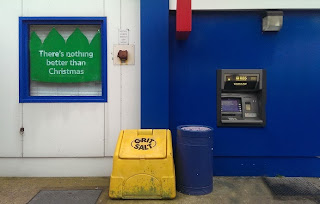
So I don't think that Christmas is starting much earlier. I reckon there's always been a holiday build-up for quite a few weeks. It's even happening here in Ringmer, with various events taking place during November and chocolate advent calendars arriving in the convenience shop. But I think what's changed is that every aspect of retailing is now Christmas-related. It's not just the must-have gifts that are being decked with boughs of holly. It's everything. Anything you're buying for yourself is "stocking up for Christmas", according to advertisers. Anything you're buying for someone else is a potential Christmas present. Headache tablets, puncture repair kits and insulating tape are for Christmas emergencies. Even a cup of coffee is now served in a merry old bowl with a slug of eggnog-flavoured syrup lurking at the bottom and a dollop of cream floating on top.
But what can we do? Well, I think Tesco has the answer. It sells hot cross buns all year round without any sight of a biblical reference or an Easter bunny. We should demand the same of yule logs, cranberry & brie vol-au-vents, figgy puddings and tinned shortbread biscuits. These should be available every day, from January to December. That way we can enjoy a proper Christmas at the proper time of year without all this marketing fuss.
First published on vivalewes.com 28th November 2013: http://www.vivalewes.com/category/east-of-earwig/
When I was a teenager, I had a Saturday job working in a toy shop. I was in the male-dominated department that dealt with Airfix kits, Hornby railways, model cars and Star Wars figures. I'd demonstrate electric trains by touching a 9-volt battery against their wheels, which I believed made me look like a worthy adversary to Magneto in the X-Men comics. Come and worship, youngsters. Our Christmas season started in November every year, just as soon as my colleagues round the corner had sold their last box of fireworks. That didn't seem too early, particularly as there'd often be a point when desperate customers needed to wait a week or two for the next delivery of ‘Simon’ from MB Games. (Batteries not included). We wouldn't tape tinsel to the cash registers until around four weeks before the big day but there was no doubting the yuletide anticipation.
Some years later I found myself working in a mobile phone shop. At this point I'd worked out that I wasn't much of a sales person but - much like my toy retailing days - rather enjoyed playing with the products. Once again, our Christmas season kicked off at the beginning of November. Mobile phones were relatively new, very exciting and became the must-have festive gift for 1995. We very literally couldn't get enough. Soon, promotion beckoned... or perhaps the regional manager was desperate to get a real salesman running one of his biggest shops. Either way, I ended up in head office where Christmas planning started as summer ended. By the time real Christmas arrived, I'd been looking at prototype cardboard decorations and seasonal puns for the past three months.
So I don't think that Christmas is starting much earlier. I reckon there's always been a holiday build-up for quite a few weeks. It's even happening here in Ringmer, with various events taking place during November and chocolate advent calendars arriving in the convenience shop. But I think what's changed is that every aspect of retailing is now Christmas-related. It's not just the must-have gifts that are being decked with boughs of holly. It's everything. Anything you're buying for yourself is "stocking up for Christmas", according to advertisers. Anything you're buying for someone else is a potential Christmas present. Headache tablets, puncture repair kits and insulating tape are for Christmas emergencies. Even a cup of coffee is now served in a merry old bowl with a slug of eggnog-flavoured syrup lurking at the bottom and a dollop of cream floating on top.
But what can we do? Well, I think Tesco has the answer. It sells hot cross buns all year round without any sight of a biblical reference or an Easter bunny. We should demand the same of yule logs, cranberry & brie vol-au-vents, figgy puddings and tinned shortbread biscuits. These should be available every day, from January to December. That way we can enjoy a proper Christmas at the proper time of year without all this marketing fuss.
First published on vivalewes.com 28th November 2013: http://www.vivalewes.com/category/east-of-earwig/
Friday, 15 November 2013
There’s no place like moan
I've recently been reminded of my last day at middle school when, as a budding 11-year-old documentary maker, I borrowed dad's cassette tape recorder and asked my teacher to speak some words of wisdom that I could remember him by. "Never trouble trouble 'til trouble troubles you", said Mr Kelly. I recall the moment well, even though my documentary-making career never really took off and I can't find the tape any more. When I think about it, those words could almost be the family motto. If mother had a coat of arms mounted on the wall in place of the kitchen clock, that phrase would be neatly lettered in Latin above a golden shield held by two Jack Russells Rampant.
Another essential family expression is 'mustn't grumble'. This one, unlike the former, isn't to be taken literally. On the contrary, it's usually only added after a minor complaint. "That Dirty Biker should never have been allowed on Strictly. Still, mustn't grumble." Yes, mum’s a fan of the BBC's Strictly Come Dancing despite not always knowing who everyone is. It's watched enthusiastically with notes taken for reference later. But I digress. Sometimes a longer story will involve the occasional use of “well, that was alright” (when it clearly wasn’t alright) to build tension until the conclusion is reached. “I couldn’t find a parking space at first but then somebody moved – well, that was alright – and then the dentist was late back from lunch. Still, mustn’t grumble.”
However, my favourite is ‘it won’t kill you’. Admittedly it’s rarely used these days but I’d hear this fairly regularly as a child. Splinters removed with needles, food that was dropped on the floor and then rinsed under the tap, foul-tasting medicine... all were heralded with “don’t fuss, it won’t kill you.” And, d’you know what? Mum was absolutely right. I am living proof that none of those things my mother reassured me about were deadly. Of course, that’s not to say they weren’t deeply unpleasant. Still, mustn’t grumble.
First published on vivalewes.com 14th November 2013: http://www.vivalewes.com/theres-no-place-like-moan/
Another essential family expression is 'mustn't grumble'. This one, unlike the former, isn't to be taken literally. On the contrary, it's usually only added after a minor complaint. "That Dirty Biker should never have been allowed on Strictly. Still, mustn't grumble." Yes, mum’s a fan of the BBC's Strictly Come Dancing despite not always knowing who everyone is. It's watched enthusiastically with notes taken for reference later. But I digress. Sometimes a longer story will involve the occasional use of “well, that was alright” (when it clearly wasn’t alright) to build tension until the conclusion is reached. “I couldn’t find a parking space at first but then somebody moved – well, that was alright – and then the dentist was late back from lunch. Still, mustn’t grumble.”
However, my favourite is ‘it won’t kill you’. Admittedly it’s rarely used these days but I’d hear this fairly regularly as a child. Splinters removed with needles, food that was dropped on the floor and then rinsed under the tap, foul-tasting medicine... all were heralded with “don’t fuss, it won’t kill you.” And, d’you know what? Mum was absolutely right. I am living proof that none of those things my mother reassured me about were deadly. Of course, that’s not to say they weren’t deeply unpleasant. Still, mustn’t grumble.
First published on vivalewes.com 14th November 2013: http://www.vivalewes.com/theres-no-place-like-moan/
Subscribe to:
Posts (Atom)


